
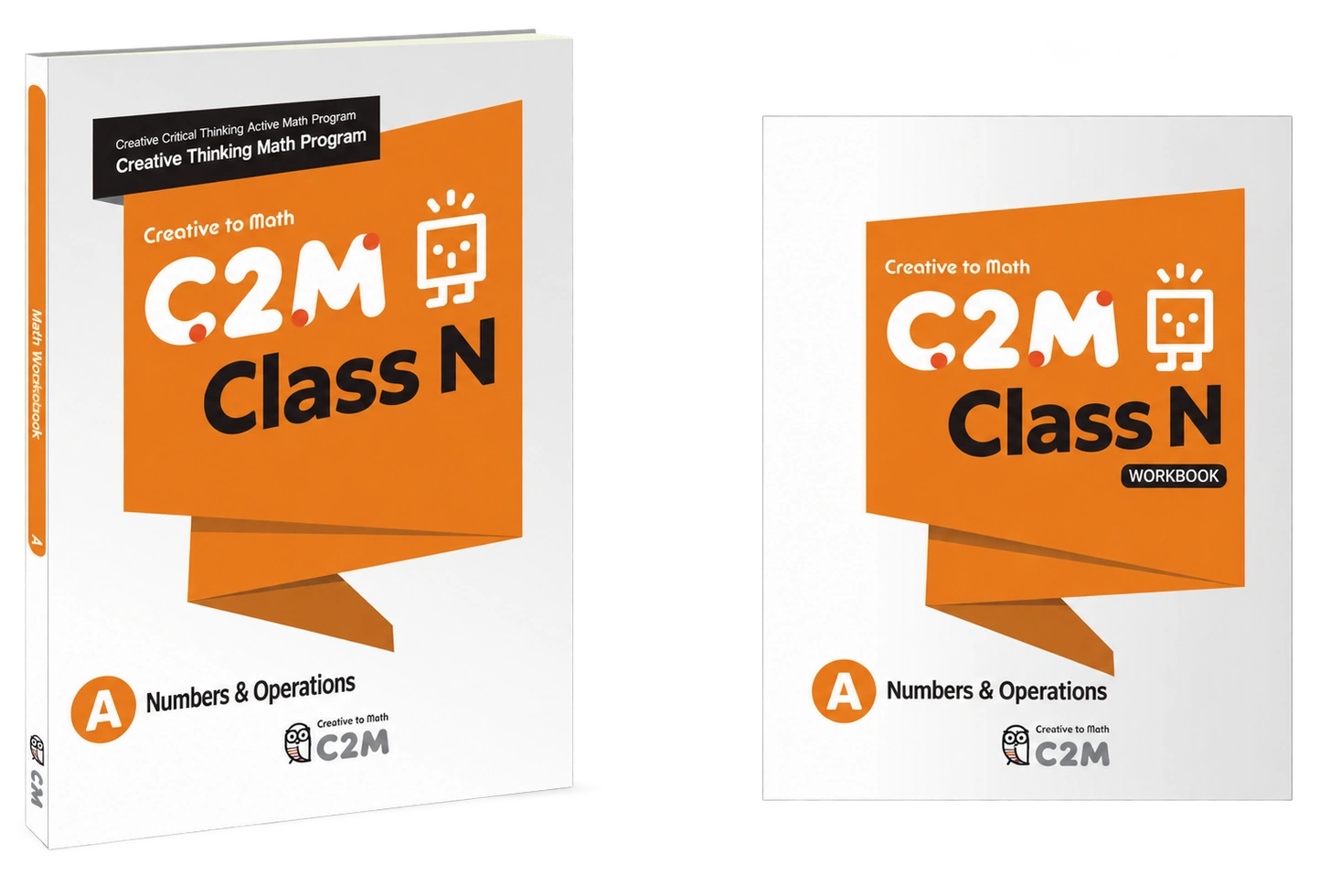
C2M Class N


Why C2M Class N?
Develops Thinking Power
By demanding various mathematical ideas during the learning process, it improves intuition, insight, and logical skills, while enriching the imagination. Various manipulative activities enhance abstraction skills.
Improves School Grades
Manipulatives are developed based on the school curriculum. The curriculum content is developed into thinking-skill content. It provides a fundamental understanding of mathematics through deeper topic exploration compared to the standard curriculum.
Convergence Math
It approaches various mathematical topics—such as the history of mathematics, stories of mathematicians, science, and real-life math—in a storytelling format. These convergence topics enrich students' background knowledge, interest, and confidence.
Program Guide
Workbooks
Composed of various topics and problem types to improve mathematical thinking and problem-solving skills for unfamiliar problem types.
Regular Textbooks : 48 books across 8 domains Special Lectures : 6 calculation special lecture books
Manipulatives
Optimized for thinking math activities and essential for the entire elementary curriculum, they improve thinking and abstraction skills through engaging activities.
8 domains – 92 types Activities for stages A~F using manipulatives specific to each domain. Manipulative activities conducted in pairs (groups of 2).
Learning Domains
Subdivides the 5 standard elementary school domains into 8 learning domains. It separates the geometry domain into plane and solid figures, the numbers domain into operations and digits, and adds problem-solving strategies.
Numbers and Operations, Numbers and Digits, Measurement, Patterns, Plane Figures, Solid Figures, Probability and Statistics, Problem-Solving Strategies
Target Audience
The C2M Class levels consist of 6 stages (Stages A to F), designed for students from 1st to 6th grade of elementary school.
Introduction
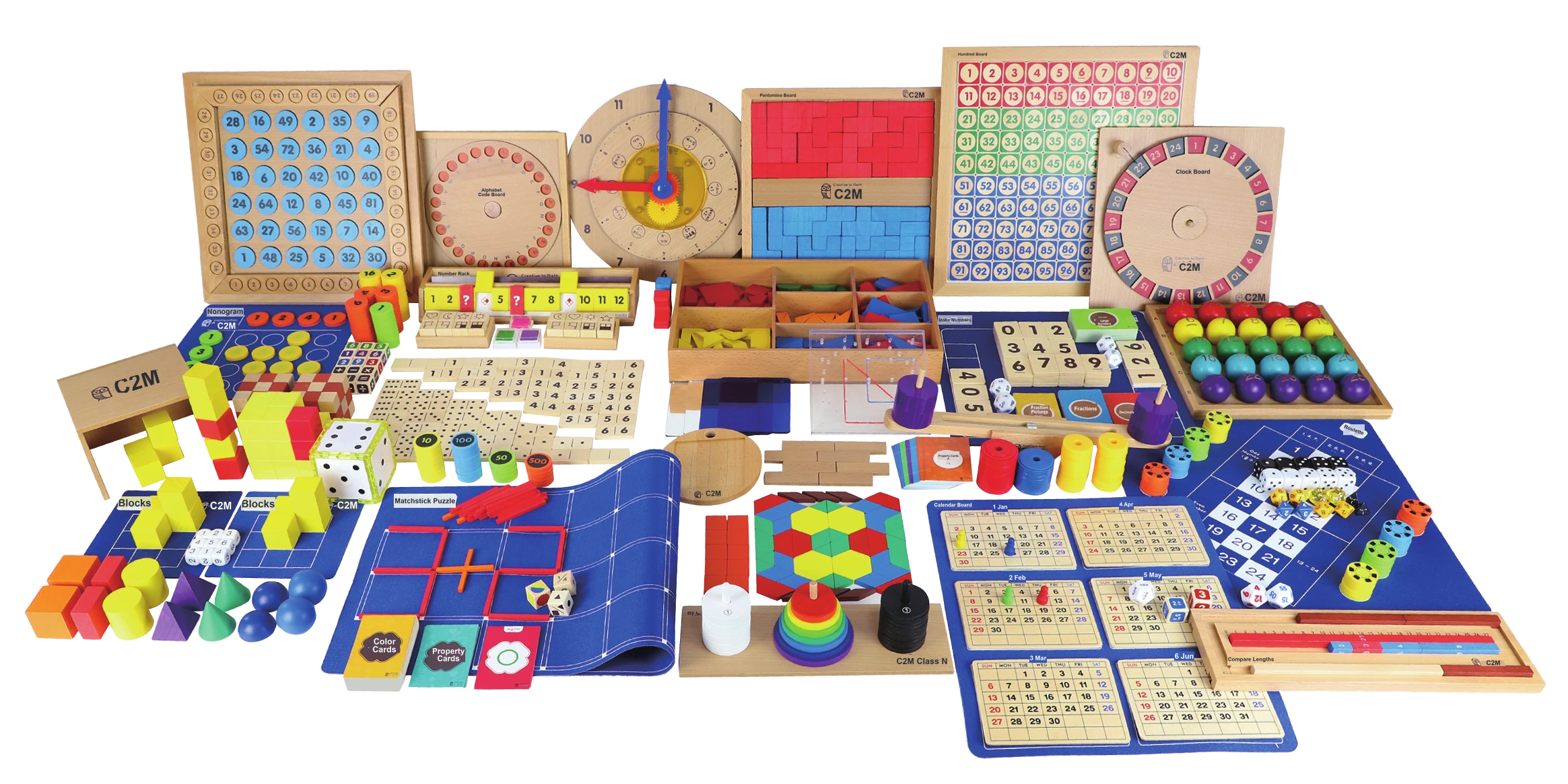
Learning Kit Components
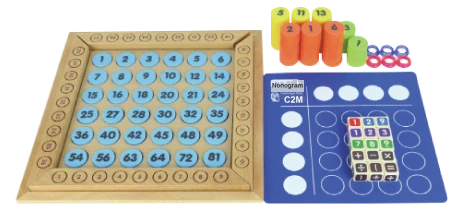
Number and Operations
Students use the four basic operations to reach target numbers, building number sense by actively working with numbers in a variety of games.
Arithmetic Bingo, Target Number Game, Nonograms
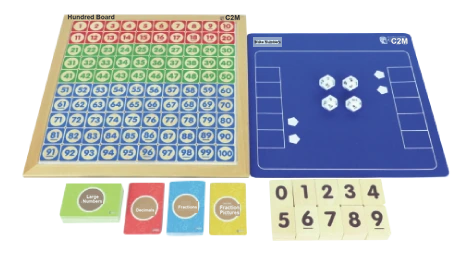
Numbers and Digits
Students explore the properties of natural numbers, fractions, decimals, and other number types, and build number sense by arranging digits to form different numbers.
Hundred Board and Thousand Board Activities, Place Value Activities, Fraction and Decimal Activities
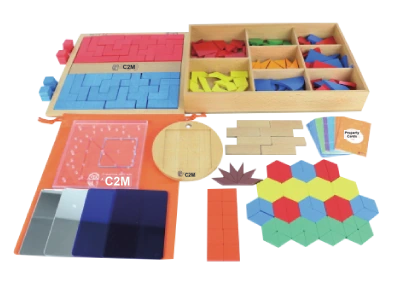
Two-Dimensional Shapes
Students identify the properties of 2D shapes using flat shape pieces. A variety of puzzle manipulatives sharpens their sense of position in 2D space and strengthens visual memory.
Translating and Rotating Shapes, Sorting Shapes by Attribute, Symmetry Activities
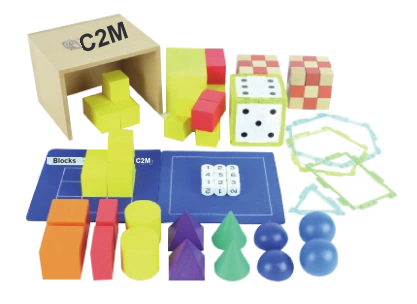
Three-Dimensional Shapes
Students build spatial awareness by designing and constructing 3D shapes, observing solid figures, and describing positions and spatial relationships.
Cubes and Stacking Blocks, GEOFLICK
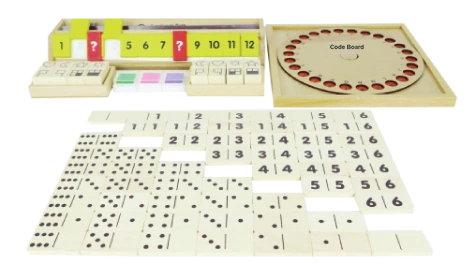
Patterns and Rules
Students strengthen their reasoning by exploring patterns, identifying rules, predicting outcomes, and creating their own patterns from rules they define.
Dominoes, Double Patterns, Repeating Patterns, Code-Breaking
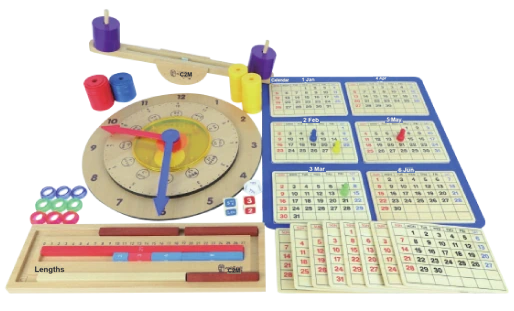
Measurement
Students use manipulatives to make the abstract idea of quantity concrete, develop an intuitive sense of size and amount, and learn key measurement topics such as length, weight, and time.
Balance Scale Activities, Clocks and Calendars, Length Rods
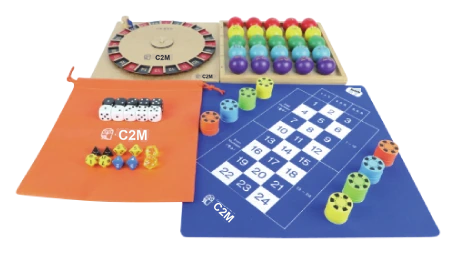
Probability and Statistics
Students build foundational probability concepts by examining how likely events are. They also strengthen reasoned decision-making by collecting, classifying, organizing, and interpreting data.
Number Spinner, Number Ball, High Five
Problem-Solving Strategies
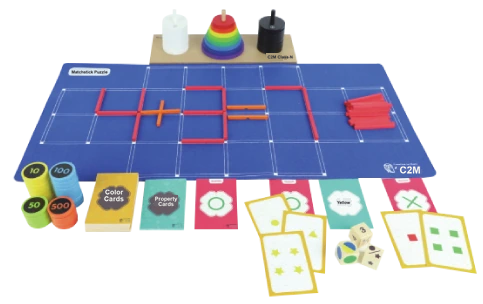
Students boost creativity and concentration by using trial and error to find the most effective ways to solve problems and by devising winning strategies for games.
Matchstick Activities, Tower of Hanoi, Coin Activities
- Levels
- Level A (Grade 1) – Level F (Grade 6)
- Composition
- 48 Core Course Books + 6 Supplementary Course Books
- Features
- The five main areas of primary math expanded into eight learning areas
Program Materials
Core Course Materials
Textbook + Workbook · 8 learning areas · 48 books across 6 grade levels
Supplementary Course Materials
Intensive Arithmetic Course · 1 book for each of the 6 grade levels
8 Learning Areas
Alongside the core strands of number and geometry, students work through a dedicated problem-solving strategies strand.
Number and Operations
Numbers and Digits
Two-Dimensional Shapes
Three-Dimensional Shapes
Measurement
Patterns and Rules
Probability and Statistics
Problem-Solving Strategies
Unit Learning
Thought Starter
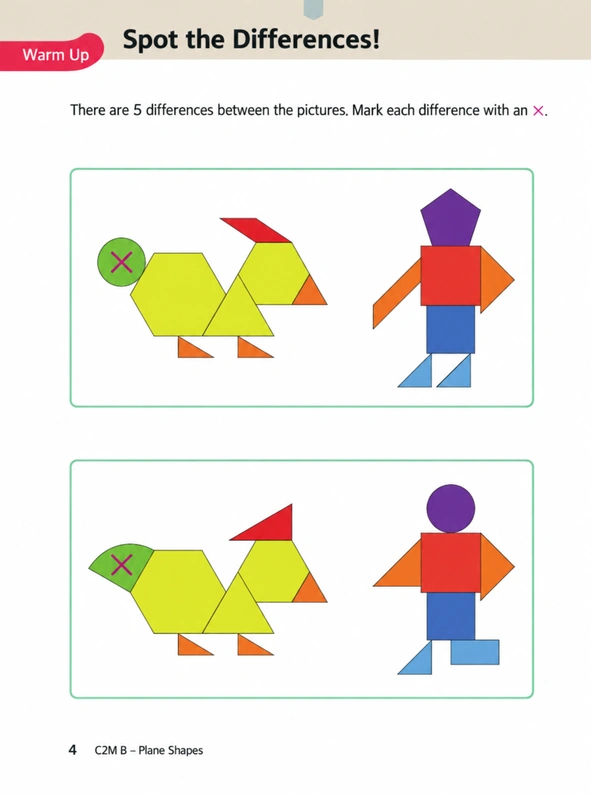
Engaging stories from science, history, art, and everyday life pose thought-provoking questions and introduce the learning objectives.
Activities 1, 2, 3
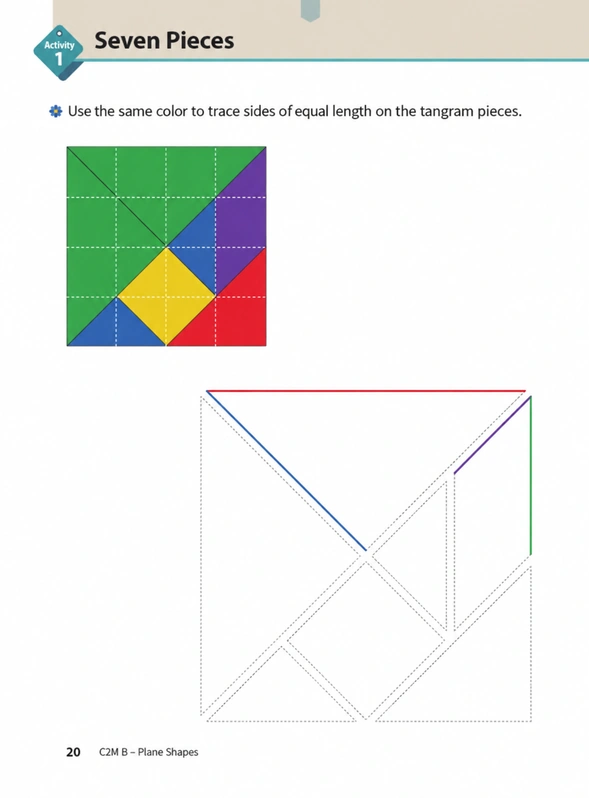
Activities are structured in small steps, progressing from simple exercises to more advanced tasks.
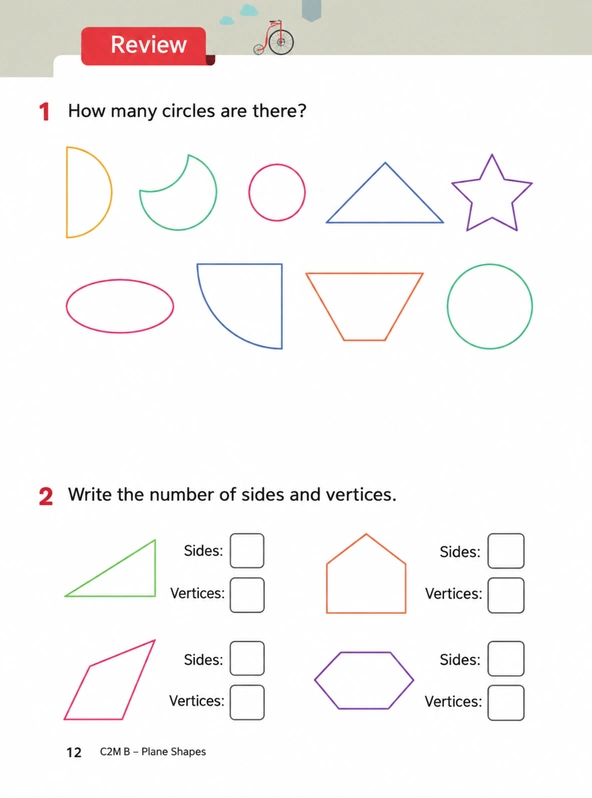
Learning Check
Students review the principles from Activities 1–3 through practice problems and consolidate the key concepts.
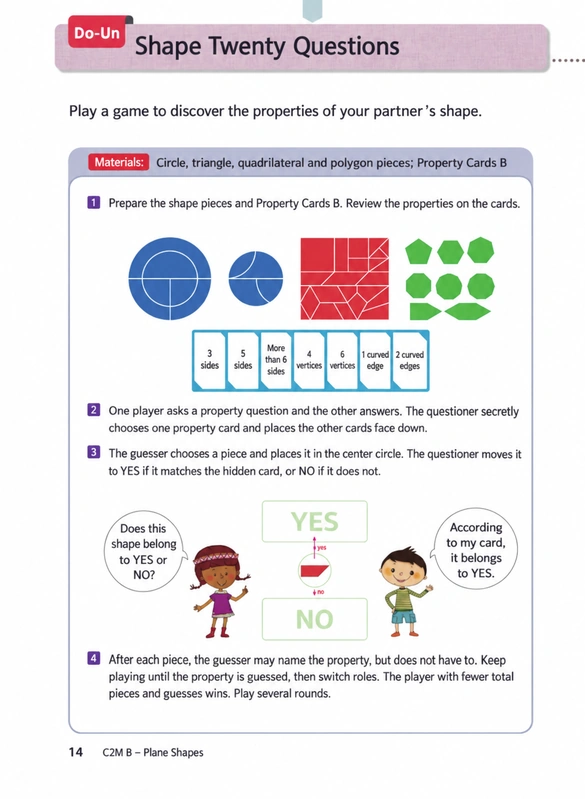
Group Challenge
Through game-based group lessons, students internalize mathematical concepts and principles, organize their own thinking, and strengthen their ability to discuss and communicate with peers.
One-Sentence Summary
Students summarize the unit's key ideas on their own and express them freely in their own words.